
Hi-Drive: Europe’s Flagship Automated Driving Project Reaches Its Destination
📍Hi-Drive EU Project Final Event and EUCAR Annual Reception, AutoWorld, Brussels, Belgium | 25th-27th November 2025
After 4.5 years of amazing work, we were proud to share our findings with an audience of over 200 during the final event of Hi-Drive this week. Concluding the fourth project over a 15-year journey with this incredible group of partners which we often refer to as our family.

Team Leeds' representatives in Brussels included (L-R) Dr Albert Solernou, Hsuan Chao, Prof. Natasha Merat OBE, Dr Courtney Goodridge, Assoc. Prof. Dr Mahdi Rezaei
Prof Natasha Merat OBE led one of the sub-projects studying users’ experiences and interactions with automated vehicles, with the aim of highlighting the understanding of users' needs and expectations, investigating how we interact with and use these vehicles as drivers, riders and pedestrians which is essential to their uptake and acceptance.
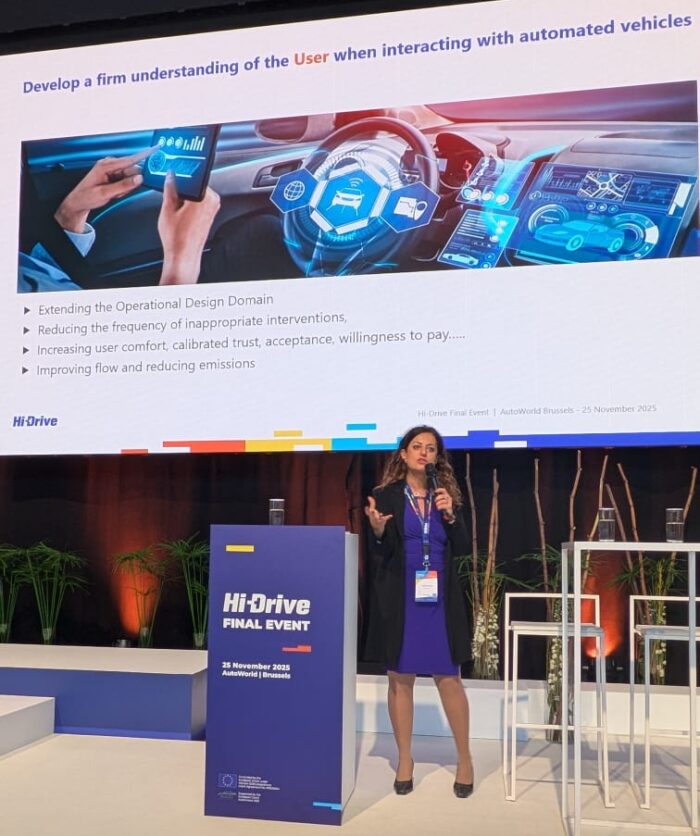
Prof Natasha Merat OBE Presenting at the Hi-Drive final event
Our project team has published over 100 open access articles and four informative deliverables- outlining the results of 60 empirical studies and two global surveys involving over 20,000 participants. The entire Human Factors and Safety group and Virtuocity are proud to be involved in Europe’s flagship project on automated driving. A full list of publications from the Leeds team can be found here: https://uolds.leeds.ac.uk/hi-drive-publications/
As part of the visit, and for the first time, we have taken our demonstration facilities abroad, thanks to the dedication of Albert Solernou, Hsuan Chao and the rest of the software developer team. Delegates were able to experience our distributed simulation between a driver and pedestrian, which has helped us develop an understanding of how implicit and explicit communication cues help road user interactions and what this means for the integration of automated vehicles in mixed traffic. We were delighted to be visited on the stand by the project's reviewers Luis Conde Bento from the Polytechnic Institute of Leiria, Jorge Villagra from CSIC, and Pedro Alfonso Perez Losa from CINEA. We were also able to demonstrate to Patrick Handisyde, Senior Policy officer from the European Commission.
Our trip in Brussels concluded with a presentation and final review to our project officer and reviewers and delegates attending the annual EUCAR reception.

Leeds Developers Hsuan Chao and Albert Solernou flank Hi-Drive Project Reviewers Pedro Alfonso Perez Losa, Luis Conde Bento and Jorge Villagra
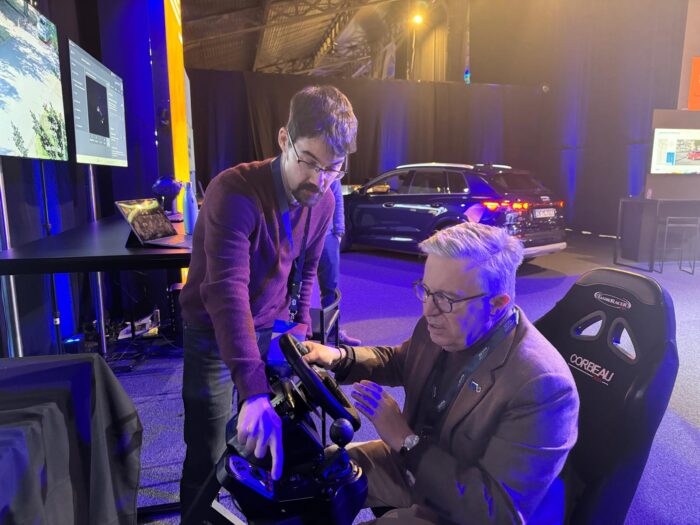
Albert Solernou introducing our distributed simulation to European Commission Senior Policy Officer Patrick Handisyde
Please see below for the full press release from the Hi-Drive team.
Hi-Drive Final Event: Europe’s Flagship Automated Driving Project Reaches Its Destination.

Brussels, Belgium, 25 November 2025. After four and a half years of pioneering research and large-scale testing, the European flagship project Hi-Drive concludes with a Final Event at AutoWorld in Brussels on 25 November 2025. This one-day exhibition and conference celebrates the successful completion of a €60 million initiative co-funded by the European Union under Horizon 2020, bringing together 53 partners from leading automotive manufacturers, suppliers, research institutions, and user organizations.
The event will feature 29 exhibits, including 16 research and prototype vehicles, 5 simulators, multiple demonstrators and themed exhibition booths, complemented by presentations, panel discussions and the opportunity to interact with some of Europe’s top experts in automated driving.
The Hi-Drive exhibition will remain on display as the backdrop for the EUCAR Annual Reception and Conference, which follows immediately after. This partnership ensures that Hi-Drive’s achievements are showcased to a broad audience of industry leaders, policymakers, and researchers during one of Europe’s most influential automotive R&D gatherings.
Showcasing the Future of Mobility
The Hi-Drive Final Event exhibition is organized around three thematic topics that reflect the project’s core achievements.
1. Vehicles, Enablers & Operations
Hi-Drive has paved the way for advanced vehicle automation by addressing the fragmentation and extension of Operational Design Domains (ODDs). Building on the foundations of L3Pilot, the project introduced modular technology enablers in V2X communication, high-precision positioning, V2X cybersecurity, and machine learning, validated through extensive real-world and
simulation testing. Cooperative manoeuvres via V2V and V2I, GNSS-denied positioning solutions, robust V2X cybersecurity protocols and advanced Machine Learning applications demonstrated resilience and scalability for future deployment.
These innovations were integrated into 37 prototype vehicles and evaluated during the Operations phase, where 20 teams conducted 45 operations on public roads and test tracks, complemented by simulation campaigns. In total, over 6,000 test runs across 38 use cases engaged 1,800 participants, covering all major road types—motorways, urban motorways, urban and rural roads, parking environments—and diverse weather and ODD conditions. This comprehensive testing demonstrated robustness and extended the capabilities of Automated Driving Functions (ADFs).
2. Effects and Impact Assessment
Hi-Drive evaluated automated driving performance using data from 45 operations pooled in 17 use-case clusters. Results show that technology enablers significantly defragment ODDs and improve driving behavior toward greater comfort, efficiency, and safety. On top of that, Hi-Drive conducted the most comprehensive impact assessment study to date for automated driving in Europe. Based on system-level modeling using the operation data for calibration, the final socioeconomic analysis revealed benefits dominated by safety and user comfort, resulting in a positive benefit-cost ratio.
3. Users
Safe and intuitive interaction with Connected and Automated Vehicles (CAVs) is essential for public acceptance. Hi-Drive gathered insights from 20,000 participants worldwide through surveys, simulators, and on-road studies to understand user needs and expectations. Safety, comfort, and the ability to engage in non-driving-related tasks emerged as key factors for adoption. Research explored driver monitoring systems, adaptive HMIs, and external communication cues (eHMIs and dHMIs) to ensure trust and smooth interaction with other road users. Innovative VR-based methods for mitigating motion sickness and frameworks for assessing comfort were developed, paving the way for inclusive and user-centric automated mobility.
NOTES
The Hi-Drive project is an Innovation Action, co-funded by the European Union under the Horizon 2020 programme with the grant agreement number 101006664. Fifty-three organisations have committed to scientifically test and assess the impact of automated driving systems on driver comfort, safety, and traffic efficiency as part of the project. www.hi-drive.eu | LinkedIn: company/hi-drive
Duration 53 months, starting from 1 July 2021 Total cost €60 million EC contribution €30 million Coordinator Volkswagen AG
Partners:
Automotive manufacturers – Volkswagen AG, AUDI AG, BMW Group, Stellantis-CRF, Ford-Werke GmbH, Honda R&D Europe (Deutschland) GmbH, Hyundai Motor Europe Technical Center GmbH, Stellantis Auto, Seat, Toyota Motor Europe, Volvo Personvagnar, Volvo Technology Corporation.
Suppliers – Aptiv, Automotive Artificial Intelligence (AAI), Robert Bosch GmbH, FEV.io, NNG, Commsignia, Planung Transport Verkehr AG (PTV), Valeo.
Research – German Aerospace Center (DLR), Institute of Communication and Computer Systems (ICCS), ika RWTH Aachen University (together with fka GmbH), Delft University of Technology, University of Leeds, Würzburg Institute for Traffic Sciences (WIVW), Institut VEDECOM, International Road Federation (IRF), Chalmers University of Technology, SNF Centre for Applied Research at NHH, Netherlands Organisation for Applied Scientific Research (TNO), University of Genova, Automotive Technology Centre of Galicia (CTAG), VTT Technical Research Centre of Finland, University of Warwick, European Center for Information and Communication Technologies (EICT)
Authorities – TÜV SÜD, The Federal Highway Research Institute (BASt)
User Groups – Federation Internationale de l'Automobile (FIA), in association with third parties: Mobilité Club France, Allgemeiner Deutscher Automobil-Club (ADAC), Automobile Club d’Italia (ACI), Avto-Moto Zveza Slovenije (AMZS), Koninklijke Nederlandse Toeristenbond (ANWB),
Automobile and Touring Club of Finland (AL), Hrvatski Autoklub (HAK), IAM Roadsmart (IAM), Magyar Autoklub (MAK), Royal Automobile Club de Belgique (RACB) and Reial Automobil Club de Catalunya (RACC)
Project coordinator: Volkswagen Group Research Aria Etemad [email protected]
Press contact European Center for Information and Communication Technologies – EICT Philippe Stehlik +49 175 1816448 [email protected]